Upper Limb Osteology & Pectoral Girdle
The Human Scapula
An in-depth anatomical and biomechanical study guide to the human scapula, detailing its triangular architecture, articular surfaces, rotator cuff anchor points, and dynamic shoulder stabilization.
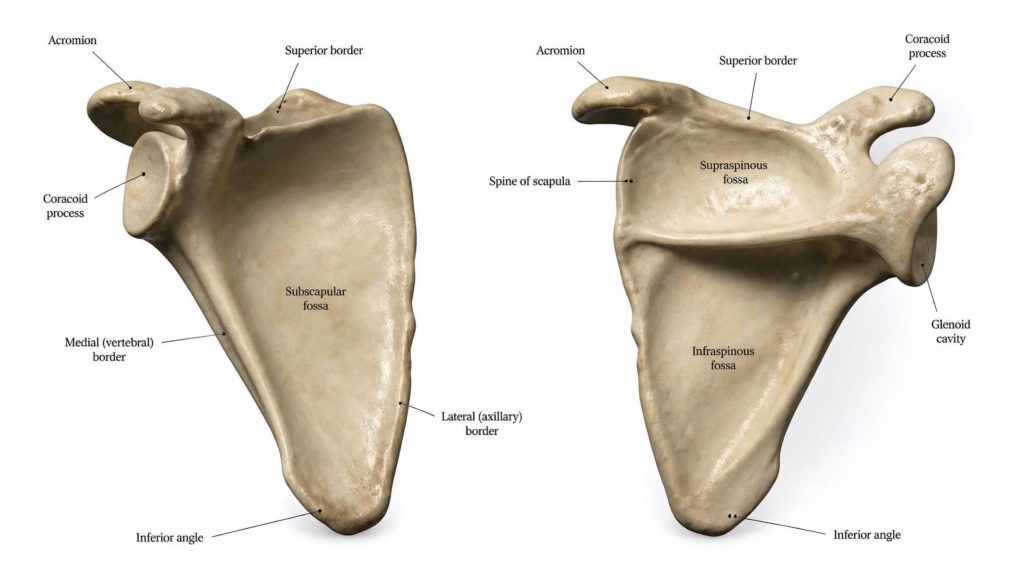
The scapula (commonly known as the shoulder blade) is a flat, triangular bone located on the posterolateral aspect of the thoracic cage, typically overlying the second through seventh ribs. Together with the clavicle, it constitutes the pectoral (shoulder) girdle, serving as a dynamic platform that connects the upper limb to the axial skeleton while enabling an exceptional range of arm motion. Surfaces, Borders, and Angles: The bone presents two principal surfaces, three borders, and three angles: Costal (Anterior) Surface: Concave and smooth, facing the rib cage to form the large subscapular fossa, which provides origin for the subscapularis muscle. Dorsal (Posterior) Surface: Convex and divided unequally by a prominent horizontal ridge known as the spine of the scapula. The spine separates the smaller supraspinous fossa superiorly from the larger infraspinous fossa inferiorly. Borders and Angles: It is framed by a superior border (bearing the suprascapular notch), a thin medial (vertebral) border parallel to the spine, and a thick lateral (axillary) border leading up to the lateral angle. Key Landmarks and Articular Processes: The lateral aspect features prominent architectural projections essential for joint formation and ligamentous attachment: Acromion: A robust, flattened anterior extension of the scapular spine that curves over the shoulder joint to articulate with the clavicle at the acromioclavicular (AC) joint. Glenoid Cavity (Fossa): A shallow, pear-shaped articular surface on the lateral angle that receives the head of the humerus to form the glenohumeral (shoulder) joint. Its depth is augmented by a fibrocartilaginous rim called the glenoid labrum. Coracoid Process: A hook-like anterior projection located just superior to the glenoid rim, anchoring the short head of the biceps brachii, coracobrachialis, and pectoralis minor muscles. Muscular Dynamics and Biomechanics: The scapula serves as the primary attachment site for 17 muscles, including the four components of the rotator cuff (supraspinatus, infraspinatus, teres minor, and subscapularis). Because it lacks a direct rigid bony fixation to the posterior thorax, it glides freely across the posterior chest wall via the scapulothoracic articulation. This coordinated movement, termed scapulohumeral rhythm, is fundamental for smooth, full-range overhead reaching and arm abduction.