Collarbone
Collarbone
A comprehensive educational study guide on the human clavicle, detailing its unique S-shaped curvature, articulations, muscular attachments, and role in upper extremity biomechanics.
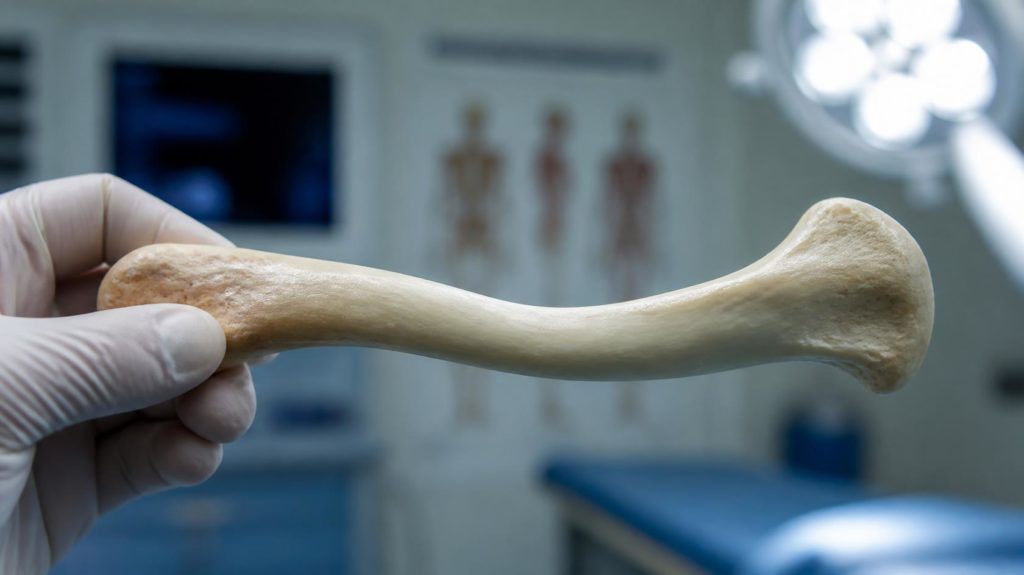
The clavicle (commonly known as the collarbone) is an elongated, doubly curved S-shaped long bone that lies horizontally across the root of the neck, bridging the axial skeleton to the appendicular skeleton. It is the sole bony strut connecting the trunk directly to the upper limb, designed to hold the shoulder joint away from the thorax to allow maximum range of movement for the arm. Morphology and Structural Divisions: Anatomically, the clavicle is divided into a shaft and two distinct articular extremities: Sternal (Medial) End: A robust, quadrangular extremity that articulates with the clavicular notch of the manubrium of the sternum and the first costal cartilage, forming the sternoclavicular (SC) joint—the only direct skeletal articulation between the upper limb and the axial framework. Acromial (Lateral) End: A flattened, broad extremity that articulates with the acromion of the scapula, forming the acromioclavicular (AC) joint supported by the coracoclavicular ligaments. Shaft (Body): Features two distinct curves: the medial two-thirds are convex anteriorly (providing space for the brachial plexus and subclavian vessels passing beneath it), while the lateral one-third is concave anteriorly. Muscular and Ligamentous Attachments: The superior surface is largely subcutaneous and smooth, whereas the inferior surface is markedly rough for ligamentous anchor points (the costoclavicular ligament impression medially, the subclavian groove centrally, and the conoid tubercle with trapezoid line laterally). It serves as an attachment site for major muscle groups, including the pectoralis major, deltoid, sternocleidomastoid, trapezius, and subclavius. Functional & Clinical Significance: Beyond acting as a mechanical strut that suspends the scapula, the clavicle transmits impact forces from the upper limb directly to the axial skeleton. Due to its superficial location and structural transition zone between its two curves, the middle third of the shaft is one of the most frequently fractured sites in the human body during direct shoulder trauma or falls onto an outstretched hand.